
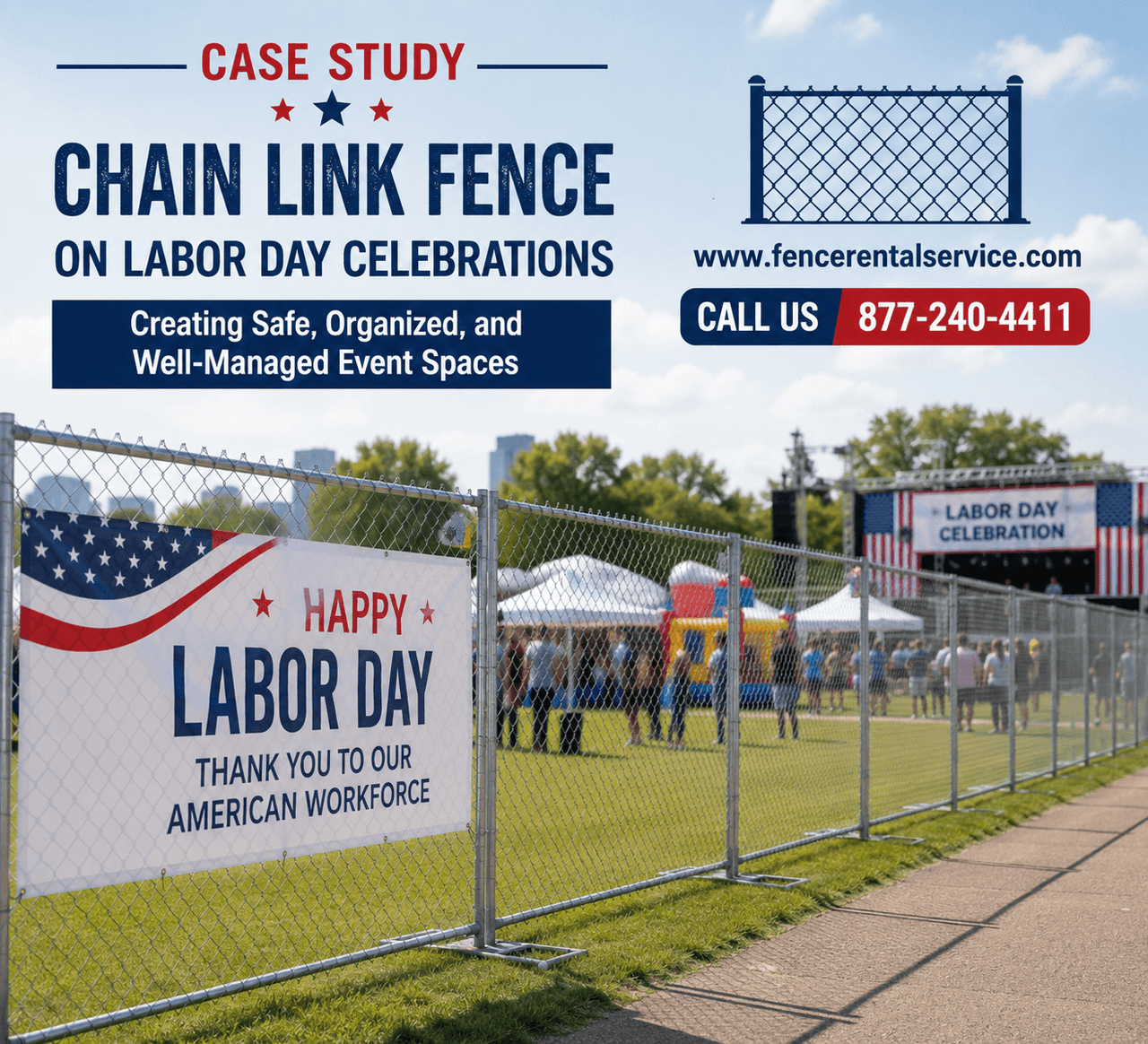
Case Study: How Chain Link Fencing Supported a Safer and More Organized Labor Day Celebration
Introduction
Labor Day celebrations often bring communities together for outdoor festivals, family gatherings, concerts, food events, sports activities, and neighborhood programs. While these occasions are designed around relaxation and enjoyment, organizing a large outdoor gathering requires careful attention to crowd movement, site boundaries, equipment protection, and public safety.
This case study examines how temporary chain link fencing was incorporated into a Labor Day celebration to create a more structured event environment. Rather than serving simply as a physical barrier, the fencing became part of the overall site-management strategy.
The Event Challenge
A community Labor Day celebration was planned across a large outdoor area that included a main entertainment stage, food vendors, children's activities, temporary storage areas, and pedestrian walkways.
The event organizers faced several practical challenges. They needed to separate public areas from restricted spaces without making the site feel closed or unwelcoming. Equipment and event supplies also required protection from accidental contact, while certain sections needed to remain accessible only to authorized staff.
Another concern was pedestrian movement. With families arriving throughout the day, organizers wanted visitors to understand where they could walk and where they should not enter. Without clearly defined boundaries, people could unintentionally enter operational areas or create congestion around popular attractions.
Planning the Fence Layout
Before the celebration began, the organizers reviewed the event grounds and identified areas requiring temporary separation.
The chain link fencing was planned around several key locations:
Equipment and storage areas
Backstage and service sections
Temporary construction or setup zones
Staff-only access points
Areas requiring controlled pedestrian movement
Sections where vendors needed separation from general visitors
The layout was designed to provide clear boundaries without unnecessarily restricting movement. Open pedestrian routes were maintained between activity zones, while restricted areas were enclosed.
This planning stage demonstrated an important principle: temporary fencing works most effectively when it is integrated into the event layout rather than added as an afterthought.
Creating Clear Boundaries
On the morning of the Labor Day event, the chain link fence established an immediate visual distinction between public and restricted areas.
Visitors could easily recognize the areas intended for general access, while staff members could identify operational zones. This reduced confusion and helped maintain a more orderly environment as attendance increased.
The fence also helped define temporary pathways. Instead of relying entirely on signs or verbal instructions, organizers could use physical boundaries to guide people naturally through the site.
This was particularly useful near busy attractions where large groups tended to gather.
Protecting Operational Areas
Behind the scenes, Labor Day celebrations involve considerable activity. Vendors bring supplies, event personnel move equipment, performers prepare for appearances, and maintenance teams require access to service areas.
Allowing unrestricted public access to these locations could interfere with event operations.
Chain link fencing provided a practical separation between these working areas and the visitor environment. Staff could perform necessary tasks without constant pedestrian interference, while guests remained within designated public spaces.
The fencing also created a visible boundary around temporary storage areas, reducing the possibility of visitors accidentally coming into contact with equipment or supplies.
Managing Crowds During Peak Hours
As the celebration became busier, pedestrian movement became one of the most important considerations.
Rather than allowing visitors to move randomly between activity areas, the temporary fencing helped create recognizable routes and boundaries. This made it easier for families to navigate the grounds and helped staff monitor areas where crowds were concentrated.
The fencing did not eliminate the need for event personnel. Instead, it complemented their work by providing a physical framework for managing the site.
Staff members could focus their attention on entrances, intersections, and busy gathering points instead of repeatedly directing visitors away from restricted areas.
Supporting Children's Activity Areas
The event included activities specifically intended for children. Because these spaces attracted families for extended periods, organizers wanted to create a recognizable boundary between the activity area and nearby operational zones.
Chain link fencing helped establish that separation while maintaining visibility.
Unlike solid barriers, chain link fencing allowed parents, guardians, and staff to see through the enclosure. This visibility was useful because adults could observe activity inside the designated space without needing to enter it.
The open structure also helped preserve the outdoor atmosphere of the celebration.
End-of-Day Site Management
When the Labor Day celebration concluded, the fencing continued to serve an important purpose.
Crowds began leaving while staff members started dismantling temporary structures, collecting supplies, and cleaning the grounds. These activities created a transition period in which certain areas were still active even though public programming had ended.
Maintaining the temporary boundaries during cleanup helped separate visitors from workers and equipment.
Once the site was cleared and inspected, the fencing could be removed as part of the overall event breakdown process.
Lessons From the Case Study
The experience demonstrated that chain link fencing can have several practical roles during a large outdoor celebration.
First, it can establish clear boundaries between public and restricted areas. Second, it can help organize pedestrian movement. Third, it can provide separation around equipment and operational zones. Finally, its open design can maintain visibility while still creating a defined physical boundary.
Perhaps the most important lesson was that fencing should be considered during the early stages of event planning. Its placement affects walkways, entrances, activity zones, vendor locations, emergency access, and staff operations.
Conclusion
A successful Labor Day celebration depends on more than entertainment and activities. Behind every well-organized outdoor event is a carefully planned environment that considers how people, equipment, staff, and temporary structures interact.
In this case study, chain link fencing became an important part of that environment. It helped establish boundaries, organize movement, separate operational areas, and support a smoother transition from event setup to celebration and finally to cleanup.
The example illustrates how a simple temporary structure can contribute to the overall organization of a large Labor Day gathering when its placement and purpose are carefully considered.